Fewer Searches and Twice as Much Traffic: How We Promoted an App in a Shrinking Market
Almost everyone believes that an app is promoted in the App Store. That you have to optimize the listing, choose the right screenshots, pay attention to the name and keywords in the App Store, and that if that’s not enough, you buy installs. I’ve heard it myself in meetings with excellent developers: “We need ASO and a campaign budget.”
It’s not false. It’s incomplete in a way that ends up being very costly.
Because only those who have already decided they want an app end up in the store. The rest of humanity—the vast majority—isn’t in the App Store. They’re on Google, searching for a solution to their problem, without yet knowing that an app exists to solve it. And there, you’re not competing with other apps in your category—you’re competing with blogs, videos, and any website that took the trouble to explain the topic better than you did.
How to Promote an App
A comprehensive strategy for promoting an app typically combines several channels:
- ASO, to increase your visibility in the App Store and Google Play.
- SEO and content, to attract people who search on Google for the problem the app solves.
- Acquisition campaigns using Google Ads, Meta Ads, TikTok, or other platforms.
- Social media, creators, and communities, to generate awareness and proof.
- Measurement and optimization, analyzing which channels generate visits, clicks to stores, installations, and repeat users.
In our case, we’ll focus specifically on the second point: how to use SEO and content to attract users who aren’t yet looking for an app.
A Challenging Case: Promoting an App That Already Has SEO Traffic
Dressika came to us in April 2024. It’s a personal color analysis app: you upload a photo, and it tells you your color season and which colors flatter you in clothing, makeup, and hair. Available worldwide on iOS and Android. And it had a problem that didn’t seem like a problem.
Dressika wasn’t starting from scratch. Its website, coloranalysis.app, was already receiving about 500 organic sessions per day and ranking in Spanish, English, and Portuguese. That sounds good. In reality, it’s the worst possible situation for promising results.
Doubling traffic to a small website is easy: you publish content, get it indexed, and every little bit helps. Doubling traffic to a website that already ranks well means taking positions away from someone who already has them and has no intention of giving them up. The top spot is already taken. And whoever holds it has been there for years.
On top of that, there were two additional factors to consider. First, a pending migration: the website was built on a custom framework and needed to be migrated to WordPress in order to produce content at scale. Every migration involves 301 redirects, and every 301 redirect results in a temporary loss of authority. Second, seven languages: Spanish, English, French, German, Italian, Russian, and Portuguese.
And here it’s worth doing the calculation that almost no one voices out loud. A reputable multilingual SEO agency charges between 1,500 and 3,000 € per month per language. Let’s take the midpoint: €2,250. For seven languages , that’s €15,750 per month. Nearly €190,000 per year for content. For a standalone app, that’s not just expensive—it’s impossible.
So the real question for the project wasn’t “How do we position this website?” It was: How do we produce specialized content in seven languages for a fraction of that budget without compromising quality?
What nobody wants to hear in the middle of a project
Let’s take it one step at a time, because the ugly part came first.
A month after the migration, the client noticed a loss of visibility for its main keywords and asked for an explanation. And rightly so. When you switch technologies and drop in rankings the following month, the obvious conclusion is that the migration has cost you money.
We analyzed each URL individually, and the diagnosis was less straightforward than a simple yes or no. Part of the decline had begun before the migration. Part of it was the known and reversible effect of the 301 redirects, concentrated on the three URLs whose structure we had changed—the only one we didn’t touch maintained its impressions, clicks, and average position without any issues. And part of it—the most troubling part—was completely beyond our control.
We looked at Google Trends. Global interest in “color analysis” had peaked in March 2024, just before we started, and had been plummeting ever since: about 50% fewer daily searches in three months.
In other words: the market was shrinking by half while we were trying to double the traffic within it.
Four Decisions: The SEO Strategies We Use to Promote the App
The first part was technical and tedious: migrating without breaking anything. Six URLs, one-to-one 301 redirects, homepage text and titles left intact, hreflang configured manually, a hierarchical heading structure, Schema in the posts, and Core Web Vitals. The URLs went from “needs improvement” to “fast” on both mobile and desktop. It’s the part of the job that nobody applauds and that, if it goes wrong, can derail the entire project.
The second: stop translating. Keyword research in Spanish cannot simply be translated into Portuguese; it must be redone from scratch. “Free online colorimetry” and “free online personal color test” are not the same search; they don’t have the same competition, and they aren’t performed by the same person. Each language was a distinct market with its own list of keywords and its own editorial calendar.
The third: producing at a pace that a team of people cannot sustain. Four articles per month per language— 28 per month—generated using microSEO —our system that orchestrates Claude and GPT-4 with Make.com and automatically publishes via WPML—and reviewed one by one by a human editor before publication. AI writes 90% of the draft; the judgment, cultural adaptation, and final approval are 100% human. The time required to produce an article went from 3–5 days to about 4 hours. In the first month, 27 posts were published.
And the fourth one—which is what really changed the project—was deciding what a conversion was.
We installed GTM and GA4 and defined a click on the download button for the App Store and Google Play as a conversion. That’s it. And it’s important to be honest about what that metric measures and what it doesn’t: it measures the intent to download, not the actual installation. The moment the user is redirected to the app store, attribution ends. That’s the most you can measure from the website, and anyone who tells you otherwise is just selling you a bill of goods.
But with that event underway, each article ceased to be a gamble and became a fact: this one brings in readers, this one brings in downloads, this one brings in nothing. The editorial calendar rewrote itself.
The Numbers: Traffic, Visibility, and Clicks to the App Store and Google Play
Between June and September 2024, organic traffic rose from about 500 sessions per day to more than 1,000, with peaks above 1,300 in September. 87% of total traffic was organic—about 100,000 users—without a single paid campaign behind it.
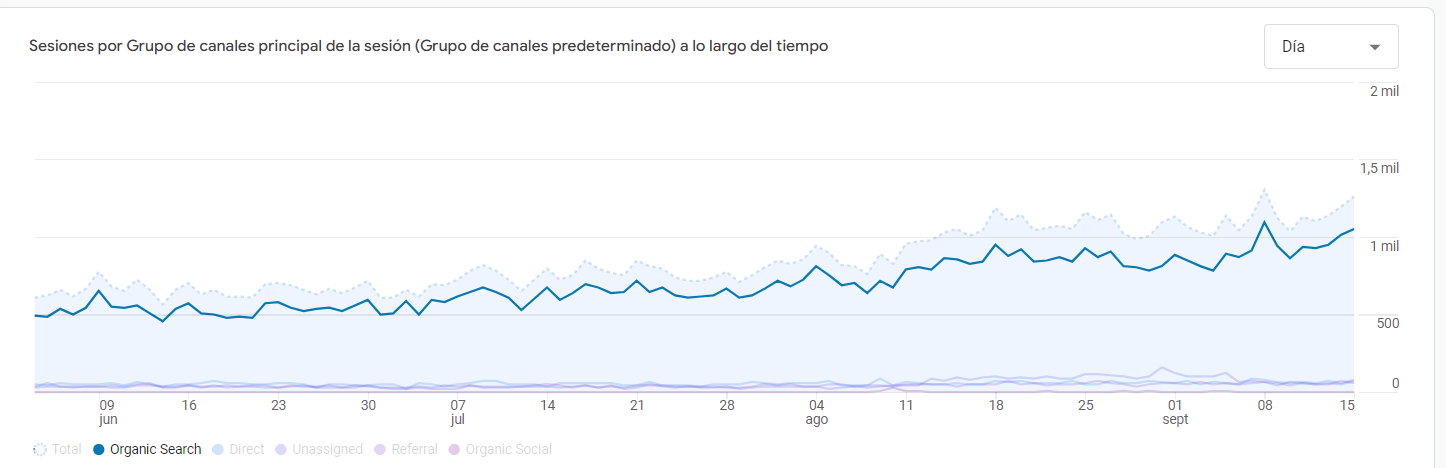
Daily sessions by channel (GA4). The dark line represents organic search; the light area represents total traffic. The two curves almost overlap: virtually all of the growth came from Google.
The project as a whole attracted 211,061 active users, with Brazil (32,935), the United States (25,775), Russia (11,383), India (10,458), Spain (9,280), and Germany (8,717) as the main markets. The domain’s Domain Rating rose from 9 to 30, and the number of organic keywords ranking reached 3,100—654 more than at the start.

Authority and keywords according to Ahrefs. The “organic traffic” figure (6.3K) is an estimate provided by the tool, not analytics data: the actual traffic numbers are those from GA4 shown in the previous chart.
And the metric that really determines whether a project like this has been worthwhile: Conversions to in-store purchases rose from 82 in May to 1,162 in September—a 14-fold increase in five months.
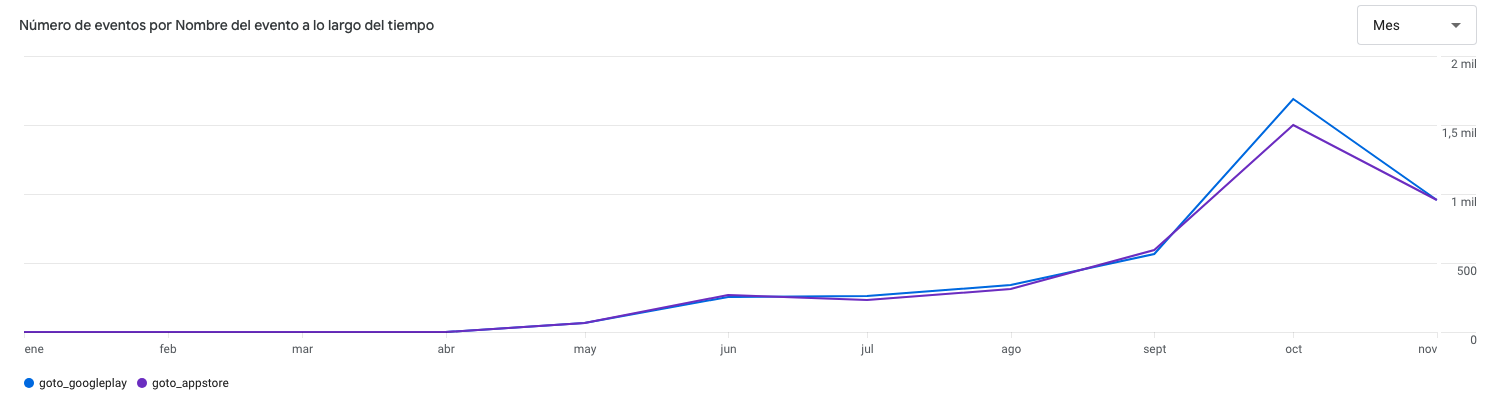
Monthly “download” button click events, broken down by store (GA4). Data through April, when the project began. The peak in October coincides with the end of the collaboration; the drop in November coincides with a month without new posts.
Look at the gap between the two curves. Traffic doubled. Clicks to the store increased fourteenfold. If the new content had simply sparked curiosity, both curves would have risen at the same time and in parallel. They didn’t. What we were getting were people in the decision-making phase.
And all of this, I repeat, while global demand in the sector has fallen by half.
The Cost of the Alternative
Let’s suppose Dressika had decided to buy those downloads instead of earning them. At a conservative cost of €2 per install—in consumer apps with competition, the cost is considerably higher—the 1,162 clicks in September would have cost about €2,300 in a single month. And at the end of the month, zero. The day you stop paying, the tap gets turned off that very afternoon.
Organic content works the other way around: you invest upfront, and then it acts like an asset. An article published in June was still bringing in users in October without anyone ever touching it again.
Although it comes with its own fine print, it’s clearly visible in the conversion chart: in November, with the project completed and no new posts, the curve drops. Starting in September, translations for some languages were discontinued, and in the subsequent comparison, the versions that continued to be published clearly diverged from those that were discontinued. In multilingual SEO, a discontinued language doesn’t just stand still—it falls behind.
The question you should ask yourself
If you have a published app, there’s one number you probably don’t know: how many people per month search Google for the problem your app solves, in each of the languages in which you could sell it.
It’s not how many people are looking for your app. It’s how many are looking for what it does.
That number exists, it can be measured, and it’s almost always between ten and one hundred times greater than the number of brand-related searches. The question is whether you’ll be on that results page—or someone else’s blog, whose owner actually took the time to do it.
How many people are looking for a solution to the problem your app solves?
We can analyze how many people search each month for the problem your app solves, which markets offer the greatest opportunity, and what content could lead them to your app.
Request an opportunity analysis for your app