
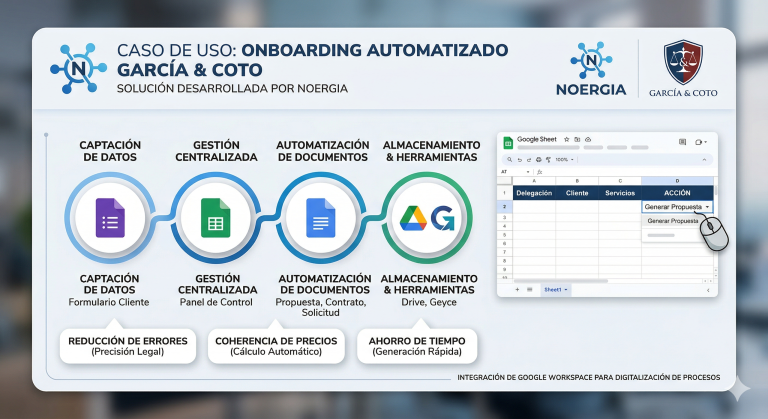

It takes your team 3 hours to sign up a new customer. We do it in 3 minutes.
That’s not hyperbole. That’s how long it took the system we built for Garcia y Coto Consulting to generate a customized service proposal, calculate fees and prepare the contract the last time we measured it.
Three hours versus three minutes. The difference is not magic: it is that they, before working with us, did things the way 90% of the consulting firms in Spain do them.
The problem no one calls a problem
When a consultancy incorporates a new client, more or less these things happen: someone picks up the phone or reads an email, writes down data in a notebook or in an Excel, opens Word, looks for the offer template from the last time, changes the name, the NIF and the services, manually calculates the fees looking at a table on paper or in another Excel, revises it because last time there was an error, sends it, waits for the client to respond. If accepted, the consultant prepares a contract, sends it, waits for the client to return it signed, saves the documents in some folder, and prays that the next person who needs it will know where it is.
All this has a cost. No one measures it, but it’s there: between two and four hours of administrative work per discharge, depending on what we’ve seen with the clients we work with. Mails come and go, the same data is entered in different places, sometimes with discrepancies. In a consultancy that takes on twenty new clients a month, we are talking about forty to eighty hours a month spent on tasks that add no value to the client.
The real problem is not time. It’s that this time turns into errors, into commercial delays and, above all, into an invisible growth ceiling: there comes a time when you can’t serve more clients without hiring more administrative staff.
What we build
García y Coto is a legal, tax, accounting and labor consultancy based in Asturias. When they came to us, their onboarding process was exactly as I have just described. Competent professionals, with good clients, but with an onboarding process that robbed them of time and generated frictions that should not exist.
The system we built for them works like this:
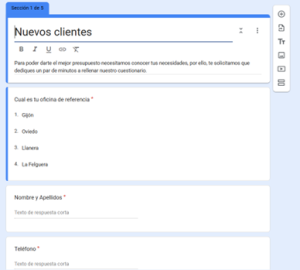
A form captures the potential client’s data. Name, type of company or self-employed, turnover, services needed. Nothing that the client does not know by heart.
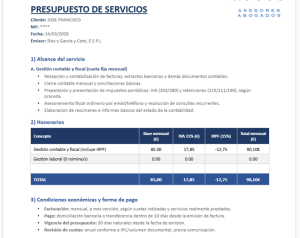
Once the form is submitted, everything else happens by itself. The system calculates the fees based on the parameters entered, automatically fills in the proposal and contract templates with that client’s specific data, generates a customized document checklist (different for a company than for a freelancer), organizes all the documents in the appropriate Drive folder, and leaves everything ready for the consultant to review and submit with one click.
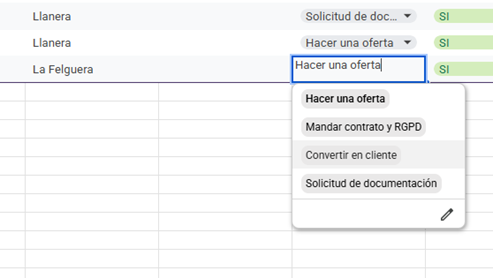
The consultant does not write anything. He does not look for a template. He does not make any calculations. He reviews, approves, sends. And he pilots all of this from his dashboard:
Why this matters more than it seems
Saving time is the easy headline. But what really changes are three things.
The first is accuracy. When the fee calculation is always done by the same algorithm with the same rules, errors disappear. Not because people are careless, but because people get tired, distracted and have a hundred other things on their minds. Machines do not.
The second is commercial speed. Before, it could take days for a customer who showed interest to receive a formal proposal, because you had to find a slot in the team’s schedule. Now they receive it in minutes, without anyone having to do anything. In an industry where first impressions matter, this is no small detail.
The third is scalability. García & Coto can double the number of monthly registrations without hiring anyone else to manage them. The system does not get tired. It does not take vacations. It does not make the Friday afternoon mistake.
The question you should ask yourself
There is a pattern that we see repeatedly in the companies we work with: the manual processes that generate the most cost are always the ones that no one considers a problem, because they have been done that way all their lives and they work, more or less.
Client onboarding in a consultancy works. Of course it works. But working is not the same as being efficient. And efficient is not the same as scalable.
The question is not whether your current process gives problems. It almost certainly doesn’t, or it does so slowly that you don’t see them. The question is how much it costs you to maintain it, how much time your team spends on tasks that might not exist, and what you would do with that time if you could get it back.
At García & Coto, the answer was clear: dedicate it to clients instead of paperwork.
Do you have a similar process in your company? Tell us about it. We can probably automate it.


