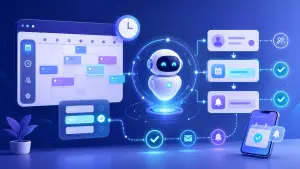

The technological revolution is radically transforming the way companies interact with their customers, and intelligent telephone agents have become the undisputed protagonists of this change. These innovative solutions are redefining the standards of customer service, combining the efficiency of artificial intelligence with the need to maintain a personalized and effective service.
Today’s customer service landscape demands fast, accurate and available 24/7 responses.
In this article, we will explore in detail the operation, benefits and applications of this revolutionary technology, as well as its impact on different industries and the trends that will mark its evolution in the coming years.
Definition and characteristics of an intelligent telephone agent
An intelligent telephone agent is an automated system based on artificial intelligence that manages telephone interactions with customers, simulating a natural human conversation and providing accurate and personalized responses in real time. This revolutionary technology combines natural language processing (NLP), machine learning and speech recognition to deliver a seamless and efficient customer service experience.
The key characteristics that define an intelligent telephone agent include: contextual understanding, enabling it to understand the intent behind the user’s words; real-time adaptability, adjusting its responses according to the tone and urgency of the query; multilingualism, being able to communicate in several languages; and continuous learning capability, constantly improving its interactions based on each conversation.
These intelligent systems are distinguished from traditional IVR (Interactive Voice Response) systems by their ability to have more natural and dynamic conversations. Unlike predefined menu-driven systems, intelligent telephone agents can process open-ended questions, understand different accents and dialects, and handle multiple queries in a single conversation, providing an experience closer to human interaction.
Benefits of implementing intelligent telephone agents in a company
The benefits of implementing intelligent telephone agents in a company are numerous and have a significant impact on operational efficiency and customer satisfaction. 24/7 availability is one of the most outstanding advantages, allowing queries to be addressed and problems to be resolved at any time, which eliminates the limitations of business hours and time zones, significantly improving the user experience.
Reduced operating costs are another key benefit, as these systems can handle multiple calls simultaneously without the need to increase staffing levels. Intelligent agents process routine queries efficiently, allowing human staff to focus on more complex tasks that require empathy and judgment. In addition, consistent responses and the elimination of human error ensure a uniform quality of service.
Scalability and adaptability represent another crucial advantage. During periods of high call volume, systems can be adjusted instantly without compromising service quality. In addition, real-time data collection and analysis provides valuable information on inquiry patterns, customer preferences and areas for improvement, enabling companies to make strategic decisions based on concrete data.
How an intelligent telephone agent works and its main components
Intelligent telephone agents operate through a sophisticated technological architecture that integrates multiple components. The process begins with the Speech Recognition System (ASR), which converts customer speech into actionable text. This technology uses advanced acoustic and linguistic models to ensure exceptional accuracy in interpretation, even in environments with background noise or different accents.
The core of the system is the Natural Language Processing (NLP) engine, which analyzes the converted text to understand the intent and context of the query. This component uses deep learning algorithms that identify patterns, extract key information and determine the best possible response. Integration with enterprise databases and CRM systems allows access to relevant customer information in real time.
The process is completed with the Voice Synthesis System (TTS), which transforms the generated responses into natural, fluent speech. This component incorporates prosodic features such as intonation, rhythm and stress, creating a more human and enjoyable conversational experience. The entire system is supported by a continuous learning engine that constantly improves its performance based on each interaction, adapting to new scenarios and refining its responses to deliver an increasingly accurate and personalized service.
Applications of intelligent telephone agents in different industries
Intelligent telephone agents have proven their versatility and effectiveness in a variety of business sectors. In the banking and financial sector, these systems handle balance inquiries, transfers and card problems, providing secure and efficient 24-hour service. Biometric voice authentication capability adds an additional layer of security for sensitive transactions.
In the healthcare sector, intelligent agents facilitate the scheduling of medical appointments, provide information on hospital services and perform post-consultation follow-ups. They also help in managing medication reminders and resolving basic questions about symptoms, referring complex cases to medical professionals when necessary.
The retail and e-commerce sector uses these systems to manage orders, provide product information, process returns and offer after-sales support. In the telecommunications sector, agents efficiently handle basic technical problems, billing queries and service change requests. The travel industry uses them for flight and hotel reservations, providing up-to-date information on schedules, availability and cancellation policies.
The utilities sector leverages these agents to manage incident reports, invoice queries and maintenance service scheduling. In education, they facilitate enrollment processes, provide course information and handle administrative queries, significantly improving the experience for students and faculty.
Trends and future of intelligent telephone agents in the industry
Intelligent telephone agents are evolving rapidly, and future trends point to deeper integration with emerging technologies. Incorporating emotional analytics capabilities will enable these systems to detect and respond to user emotions in real time, adjusting their tone and approach to provide a more empathetic and personalized experience.
Integration with blockchain technology is emerging as a significant trend, especially in sectors that require high security such as banking and healthcare. This integration will enable more secure and verifiable transactions, while the implementation of advanced biometric technologies will improve user authentication and fraud prevention.
The future also points to hyper-automation, where intelligent telephone agents will integrate seamlessly with other enterprise automated systems, creating a cohesive digital ecosystem. The incorporation of
The development of